Salon software cost per year: a simple budget guide
 By the DaySync team. Drafted with Lissa, our AI writing assistant.

A booking app costs $25 a month. You multiply by twelve, write down $300, and move on.
Then you add another stylist. You need more text messages. A paid feature becomes part of the routine. By December, the total looks different from the number you wrote down in January.
To work out your salon software's cost per year, add the subscription, staff or location charges, paid extras and usage fees across twelve months. Include setup costs in the first year. Show payment processing separately so you can compare the full cost of taking bookings and payments without confusing the two.
A simple budget will do. The useful part is choosing assumptions that match your salon.
Start with the subscription you will actually buy
Check whether the advertised monthly price requires annual payment. A plan described as “$25 per month, billed annually” means $300 paid for the year. A monthly contract at $30 would cost $360 over twelve months.
That is a $60 difference in this hypothetical example, but the payment timing matters too. Paying less overall may still mean paying more upfront.
Record the renewal price, the end of any introductory discount, and whether tax is included. If you expect to use the software for only part of the year, check the cancellation and refund terms before treating the unused months as money you will recover.
Count people the way the provider counts them
“Three employees” does not always mean three billable users. A provider might charge by bookable calendar, staff login or location. Check whether the owner is included in the advertised allowance and whether a receptionist needs a paid account.
Imagine a fictional plan costing $30 a month for the first bookable person, plus $10 for each additional person:
| Bookable people | Monthly subscription | Twelve-month subscription |
|---|---|---|
| 1 | $30 | $360 |
| 3 | $50 | $600 |
| 6 | $80 | $960 |
These figures illustrate the pricing model; they are not a vendor quote.
Account for hiring dates as well. If you have three bookable people for six months and six for the next six months, the subscription would be $780: six months at $50 plus six months at $80.
This is why a useful salon software budget includes the team you expect to have later in the year.
Add the extras your salon will use
Read the plan details with an ordinary working week in mind. Can clients book the services you offer? Can the whole team see the schedule? Does the included message allowance cover your actual appointments?
Possible extra costs include text messages, marketing tools, consultation forms, additional locations, data migration, hardware or support packages. Enter only the ones that apply to your chosen service.
For a usage-based feature, write down both the rate and the expected quantity. If a hypothetical message service charges $0.05 per billable message and you send 600 a month, budget $30 a month, or $360 a year. Check how the provider defines a billable message, including long messages and destinations.
A small unit price becomes meaningful when it repeats every working day.
Separate marketplace fees from payment processing
A marketplace introduction fee and a card-processing fee pay for different things. They may also apply to different transactions.
If a platform charges for qualifying new-client bookings, estimate the number of bookings that qualify and apply its published fee rules, including any minimum. Do not apply a first-visit fee to every returning appointment.
For card processing, use your actual card volume and transaction count. At an illustrative rate of 2.6% plus $0.10 per transaction, a salon taking $10,000 by card across 200 transactions each month would pay:
- Percentage charge: $10,000 × 2.6% = $260.
- Transaction charge: 200 × $0.10 = $20.
- Total: $280 a month, or $3,360 a year if activity stays the same.
This is arithmetic, not a quote. Your provider may have different rates for different payment methods.
Include processing for every option you compare, even when the booking software and payment provider are separate businesses. A booking app with no booking commission does not make card acceptance free.
Copy this annual budget table
Use a separate column for each provider, keeping the same team size, booking volume and payment assumptions throughout.
| Cost | How to calculate it | Annual total |
|---|---|---|
| Base subscription | Actual charge for each month, or annual invoice | $___ |
| Extra people or locations | Applicable charges over the months used | $___ |
| Paid features | Each selected add-on × months active | $___ |
| Messages and other usage | Expected billable units × rate | $___ |
| Marketplace fees | Qualifying bookings under the provider's rules | $___ |
| Booking and software subtotal | Sum of the five rows above | $___ |
| Payment processing | Card volume × rate, plus transaction charges | $___ |
| Setup, migration and hardware | First-year purchases and fees | $___ |
| Applicable taxes | Tax on the relevant charges | $___ |
| First-year total | Subtotal plus processing, setup and taxes | $___ |
Keep a second total for the following year. Remove one-time setup costs, but update renewal prices and expected usage.
Where DaySync fits in the calculation
As of October 4, 2026, DaySync's published plans are below. People limits include the owner.
| Plan | People | Monthly billing | Twelve monthly payments | Annual billing |
|---|---|---|---|---|
| Free | Up to 2 | $0 | $0 | $0 |
| Pro | Up to 5 | $12 | $144 | $120 |
| Business | Unlimited | $25 | $300 | $250 |
These prices are in US dollars, per business rather than per person. In the App Store and Google Play, the price shown for your country applies. Payroll and commission calculations are on Business, so choose for the features you need as well as team size.
Run your own numbers through the hiring example from earlier. A three-person team fits on Pro: $144 over twelve monthly payments, or $120 paid yearly. If that team grows to six in July, it needs Business from then on. Six months of Pro at $12 plus six months of Business at $25 comes to $222 on monthly billing, against $300 for Business all year, or $250 paid yearly.
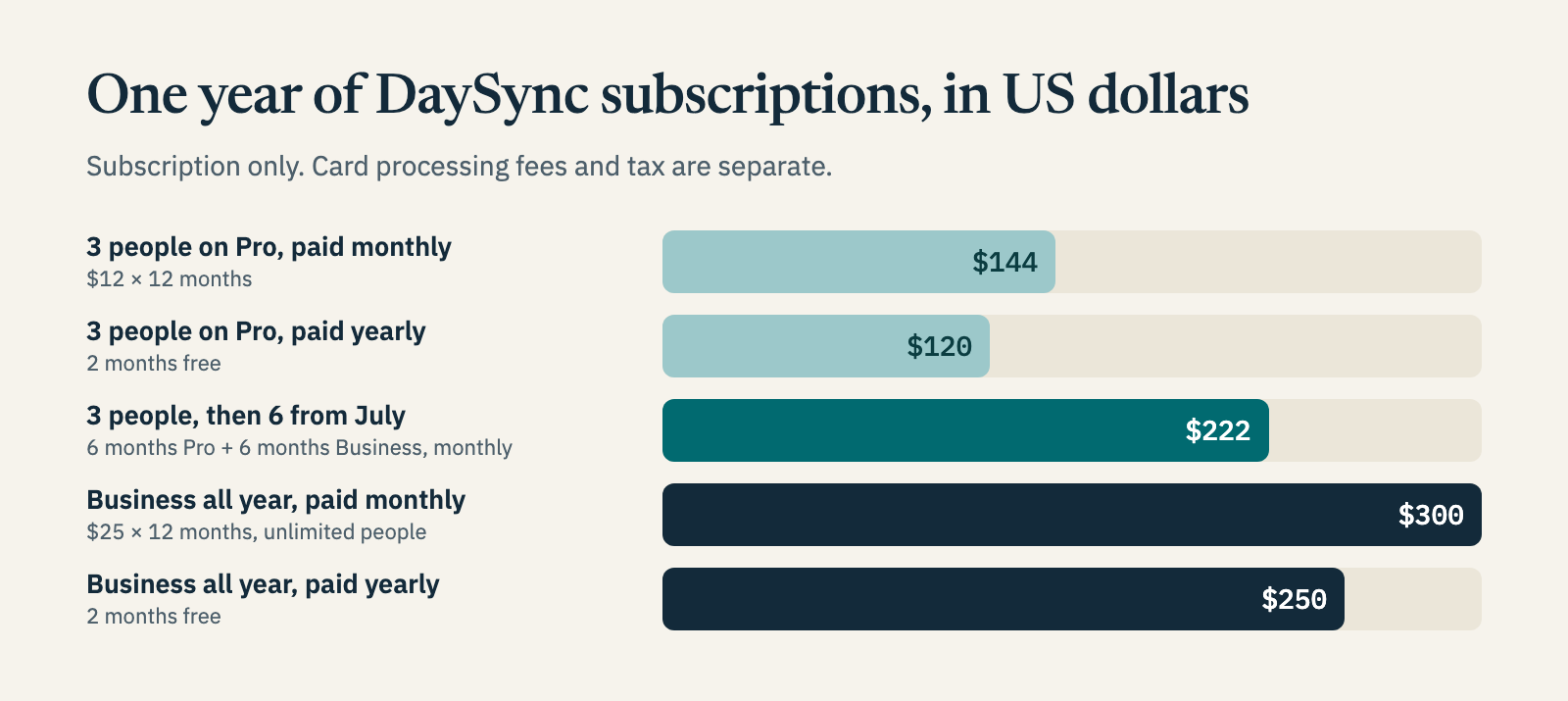
Those are subscription figures. Add your payment-provider costs and any other services your business needs to complete the budget. DaySync records how a visit was paid; cash, your own card terminal and transfers do not run through DaySync.
For a broader shortlist, use the salon software pricing comparison, then confirm the current terms directly with each provider.
Before choosing, run two versions of your budget: the salon you operate today and the salon you expect to operate six months from now. A price that still makes sense after the next hire is easier to plan around.