How to calculate salon commission: worked examples
 By the DaySync team. Drafted with Lissa, our AI writing assistant.

It is Friday evening. The last client has left, and you are checking the team's pay. One stylist remembers a discounted color appointment. Another sold three bottles of shampoo. A refund landed yesterday for a service from the previous week.
You know everyone's percentage. You still have several questions to answer.
To calculate salon commission, multiply the sales eligible for commission by the agreed rate. Calculate service and retail commission separately if they use different rates, then add the results.
The arithmetic takes seconds. Defining which sales count is what makes the number reliable. That is as true for a barbershop with commission barbers or a nail studio with a few techs as for a hair salon.
Start with the amount the percentage applies to
The commission base is the amount of sales used to calculate commission. A clear agreement defines that amount before the work happens.
For example, a $100 service discounted to $80 produces two possible calculations at a 40% rate:
| Agreed basis | Calculation | Commission |
|---|---|---|
| Listed service price | $100 × 40% | $40 |
| Discounted service price | $80 × 40% | $32 |
Neither calculation tells you which arrangement your salon has agreed to. The difference is $8 on one appointment, so it is worth making the rule explicit.
Write down how your arrangement handles discounts, refunds, sales tax, tips, packages and appointments shared between two people. Keep tips and tax in separate fields so they do not accidentally enter the service-sales total.
Decide when a sale becomes eligible, too. If your arrangement counts completed services, a deposit collected for next month's appointment should not quietly become this month's commissionable service revenue.
A worked example: services plus retail
Imagine a stylist whose agreed rates are 40% on eligible service sales and 10% on eligible retail sales. These are illustrative rates, not recommendations for what a salon should pay.
For this pay period, the agreed service base is $1,800 and the retail base is $150.
| Category | Eligible sales | Rate | Commission |
|---|---|---|---|
| Services | $1,800 | 40% | $720 |
| Retail | $150 | 10% | $15 |
| Total commission | $735 |
That $735 is the commission component. It is not automatically the stylist's complete gross pay or take-home pay. Hourly wages, other earnings, payroll deductions and applicable wage requirements need their own treatment.
If a product is refunded, record the event and check the agreed, legally permitted treatment. Do not silently subtract it from someone's next payment because that is the easiest spreadsheet edit.
Tiered commission: specify how the higher rate works
A phrase such as "45% after $2,000" leaves room for an expensive misunderstanding.
Suppose a stylist generates $2,500 in eligible service sales during the measurement period. The arrangement pays 40% up to $2,000 and 45% above that threshold.
Under a marginal tier, the higher rate applies only to sales above $2,000:
- First $2,000 × 40% = $800.
- Remaining $500 × 45% = $225.
- Total service commission = $1,025.
Under a whole-period tier, reaching the threshold could instead trigger 45% on all $2,500. That produces $1,125.
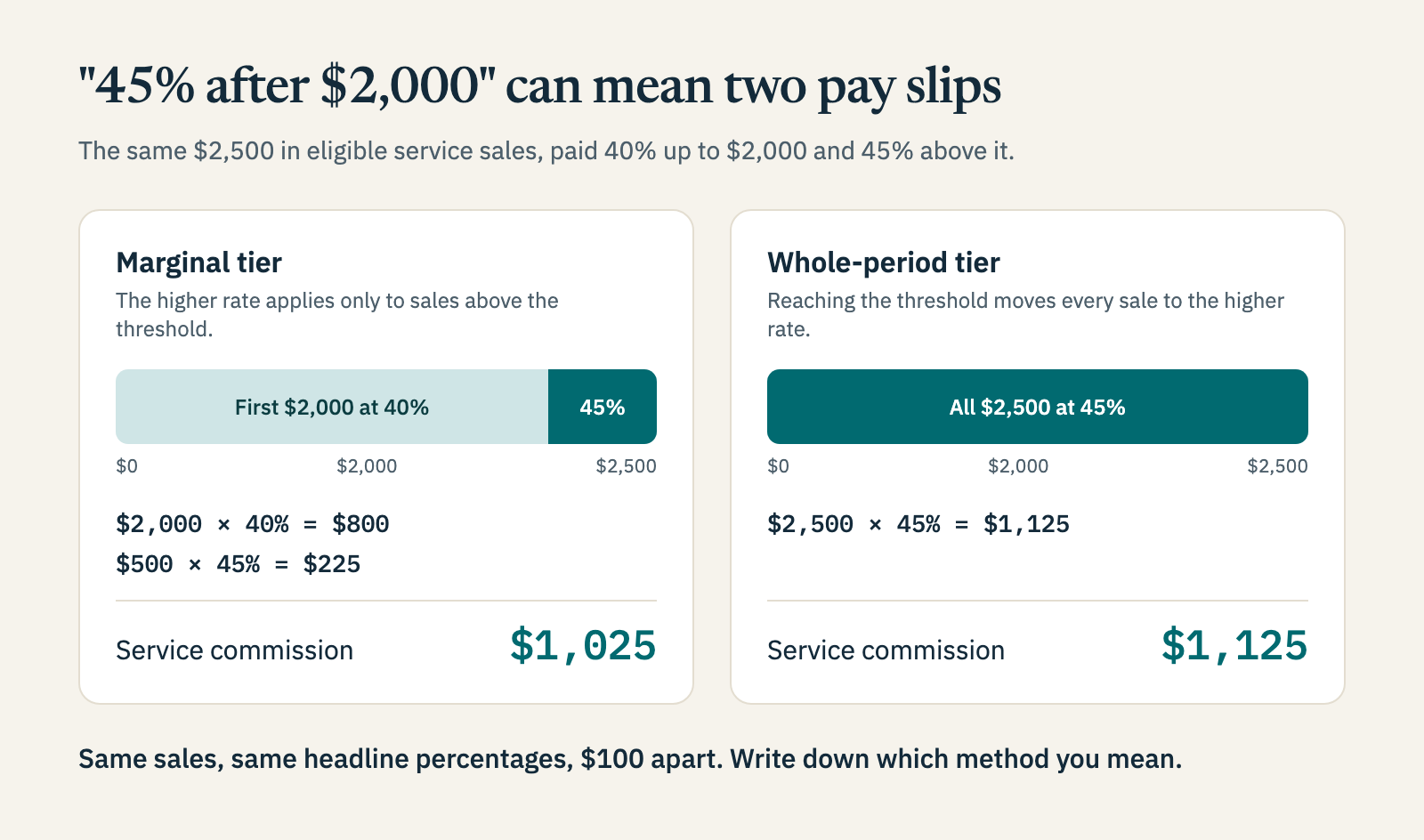
The same sales and headline percentages produce a $100 difference. Name the method in the agreement, define when the threshold resets, and include a worked example everyone can follow.
Build a worksheet that someone else can check
A useful salon commission spreadsheet needs a clear trail from each sale to the final total. Start with these columns:
| Field | What to record |
|---|---|
| Date and transaction reference | Enough detail to find the original sale |
| Team member | The person credited with the work or product sale |
| Category | Service or retail |
| Eligible amount | The commission base under the agreed rules |
| Rate | The applicable percentage |
| Commission | Eligible amount multiplied by rate |
| Note | The reason for any adjustment or split |
For a flat-rate row, if the eligible amount is in D2 and the rate is in E2, the spreadsheet formula is =D2*E2. Enter 40% as 40%, not 40.
Keep service and retail subtotals visible. For tiered arrangements, use a separate summary calculation for the defined measurement period; a simple flat-rate formula will not handle the threshold on its own.
Before closing the period, check that every completed sale appears once, shared services follow the agreed split, and adjustments have a reference. Give each team member a breakdown they can review before small mistakes become recurring disputes.
Keep commission calculations separate from payroll compliance
In the US, paying commission does not by itself remove overtime obligations. The federal exemption for certain commissioned retail and service employees has specific conditions. The US Department of Labor explains those conditions here. Rules in other countries differ, so check the ones that apply where you work.
Have your payroll provider check the full arrangement against applicable federal, state and local requirements, including wage minimums and any proposed deductions. A correct percentage calculation is only one part of correct pay.
Make the next pay period easier
Set aside ten minutes before the next period starts. Confirm the commission base, write one example for each rate, and agree on how questions will be resolved.
If you run a team on DaySync, payroll on the Business plan works out each pay period from completed appointments: you set a service rate and a retail rate for each team member, and tips show next to commission. It uses flat rates, so a tiered arrangement like the one above still needs a spreadsheet. It calculates and records pay but does not send money, and it is not on Free or Pro. Business is $25/month or $250/year for unlimited people; see pricing. Check that the setup matches your agreement, especially discounts and refunds.
The goal is a payment you can explain without reconstructing two weeks of appointments. When the rules are clear and the records are complete, Friday evening gets shorter.